
Running advertisements is simple in the modern digital age. However, one thing is necessary for running ads that truly produce leads, revenues, and true business growth: collecting the appropriate data.
Performance Marketing Metrics become crucial at this point. Every campaign should be evaluated and optimised using actual data since Performance Marketing is entirely result-driven.
Because they just pay regard for views, likes, and impressions, numerous companies spend money on ads. Yet, knowing the campaign’s analytics is crucial for digital marketing’s ultimate achievement. You can scale your campaigns with confidence, lower your ad spend, and increase your outcomes if you monitor the appropriate data.
The most crucial Performance Marketing Metrics that each company has to monitor in order to see steady growth will be explained in this blog.

Why Performance Marketing Metrics Are Important ?
Measurable outputs are the primary objective of performance marketing. Performance marketing enables exact understanding into what is and is not successful, compared with traditional marketing techniques, where results are difficult to measure.
Monitoring Performance Marketing Metrics benefits you in the following ways:
- Recognise where the funds are going.
- Find what campaigns are producing results.
- Strengthen audience selection and targeting.
- Multiply your revenue and conversion rates.
- Get a leash on unproductive expenditures.
- Make better educated decisions about your advertising strategies.
You are essentially running advertisements blindly if you don’t have tracking. However, you may constantly refine campaigns and create a solid expansion system for your company by measuring the appropriate Performance Marketing Metrics.
The Most Essentials for Performance Marketing Metrics
Ad platforms provide an extensive list of marketing metrics, but not all of them can be considered significant. The most significant Performance Marketing Metrics with an actual impact on the growth of businesses are:
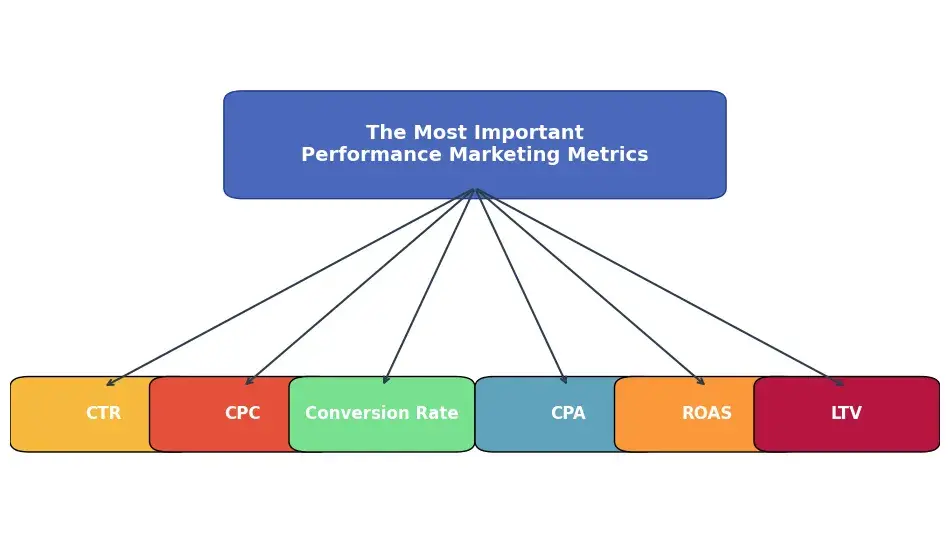
Click-Through Rate (CTR)
It is the total count of interactions on your ad.
CTR Formula:
CTR = (Clicks / Impressions) × 100
A greater CTR indicates that the campaign appears acceptable and enticing to the target population. CTR is one of your most important Performance Marketing Metrics since it shows how well the idea, headline, and offer work together.
Ways to raise CTR:
- Ad copy should be kept simple.
- Make call to action (CTA).
- Use attractive images or videos.
- Experiment with different ad styles.
- Select the right audience for targeting.
The CTR is the first evidence that people are beginning to pay interest in your ad.
Cost Per Click (CPC)
CPC is the cost you pay for every time your ad is opened. Because it indicates the cost of driving traffic to your website or landing page, this measure is crucial.
CPC Formula:
CPC = Total Spend / Total Clicks
You may be targeting a competitive audience or employing subpar ad creatives if your cost per click (CPC) is high.
How to reduce CPC:
- Improve ad relevance score.
- Use better creatives and headlines.
- Target a more specific audience.
- Optimize placements.
- Improve CTR (higher CTR often reduces CPC).
Among all Performance Marketing Metrics, CPC directly affects your budget efficiency.
Conversion Rate (CR)
The conversion rate is the count of consumers that took the desired step after seeing you add. A conversion can be stated as a transaction, form submission, WhatsApp message, or app installation.
Formula:
Conversion Rate = (Conversions / Clicks) × 100
Conversion Rate is one of the most vital Performance Marketing Metrics, since clicks do not ensure success of the business. Conversions are what generates revenue.
How to increase the rate of conversion:
- Optimize landing page speed.
- Use a clear CTA button.
- Add trust elements like reviews and testimonials.
- Improve website design and layout.
- Make straightforward offers.
If your ads receive good conversion rates, then you need not worry.
Cost Per Acquisition (CPA)
It shows how much it costs you to get one conversion.
CPA Formula:
CPA = Total Spend ÷ Total Conversions
CPA is a crucial Performance Marketing Metrics as it directly tells you whether your campaign is profitable or not. The revenue generated to get one lead should cover the expenses generated for the conversion.
How to reduce CPA:
- Concentrate on audience segmentation and targeting.
- Retargeting campaigns are to be used.
- Simplify your landing pages.
- Take steps to increase your conversion rates.
- Do a trail or error method with creatives and ad copies.
A lower CPA = higher profit margins and better campaign scalability.
Return on Ad Spend (ROAS)
It measures what profit you made from each rupee you spend on marketing.
ROAS Formula:
ROAS = Revenue from Ads ÷ Total Ad Spend
As it defines the relation between ad spends and the revenue generated, ROAS is an important Performance Marketing Metrics for you to have focus on. For example, your return on assets (ROAS) is four times if you invest ₹10,000 and earn ₹40,000.
How to improve ROAS:
- Target high-intent audiences.
- Enhance product offerings as well as prices.
- Upsell and cross-sell goods.
- Use Conversion optimized landing pages.
- Run retargeting ads.
- Reduce CPA while increasing conversion value.
Once companies become capable of using ROAS to their advantage, they tend to stop wasting money.
Customer Lifetime Value (CLV / LTV)
The entire amount of money an entity generates from a consumer over a long stretch of time is known as customer lifetime value.
Many marketers just worry about one-time sales, but genuine business growth occurs when you acknowledge the intrinsic value of the people you serve. LTV is one of the most underrated Performance Marketing Metrics because it helps you understand long-term profitability.
For example, if your CPA is ₹500 but your customer spends ₹5000 over 6 months, then your campaign is highly profitable.
Why LTV matters:
- Helps in scaling ads aggressively.
- Supports long-term business strategy.
- Helps calculate real ROI.
- Improves retention marketing decisions.
LTV is especially important for subscription businesses, ecommerce brands, and service-based businesses.
Bounce Rate and Landing Page Engagement
This is the percentage of those visitors who just visit your landing page and leave without taking any action.
Poor landing page performance can affect your business even with a performing ad. Thereby, making Bounce rate an important Performance Marketing Metrics.
Important landing page engagement indicators include:
- Bounce rate
- Average session duration
- Scroll depth
- Page speed
- CTA click tracking
How to reduce bounce rate:
- Improve page loading speed.
- Match landing page content with ad message.
- Use clear headlines and CTA.
- Avoid too much text.
- Create Mobile Responsive pages in your website.
Keep your landing page clean and creative as you know, first impression is the best impression.
Impression Share
It is simply the calculation of frequency of your ad vs its potential, and this is mostly used for Google Ads.
A low impression share may indicate:
- Budget is too low
- Your bid is too low
- Competition is high
- Ad rank is poor
Impression share is one of the most useful Performance Marketing Metrics when you want to scale. If your campaign is profitable and impression share is low, it means there is a big opportunity to increase budget and gain more results.
Top Resources for Monitoring Performance Marketing Metrics
With the right tools you can master your Performance Marketing Metrics:
- Google Ads Dashboard are for search, display, and YouTube ads.
- Analytics of Meta Platforms are tracked by Meta Ads Manager.
- You can learn more about your website’s users’ origins, their interactions, and the precise steps they take before converting with the aid of Google Analytics 4 (GA4).
- Google Tag Manager will assist in managing tracking pixels and events.
- Microsoft Clarity/Hotjar offers heatmaps and session recordings for understanding user involvement.
Common Mistakes While Tracking Performance Marketing Metrics
Here are some of the wrongly focused Performance Marketing Metrics for you to avoid:
- Focusing on Engagement only:
Likes and Impresisons looks good, but conversions and ROAS is what actually matters.
- Gap in Conversion Tracking:
Keep a record of your conversion for making informed decisions instead of guessing.
- Not paying attention to Landing Page Performance:
A very badly designed landing page can kill your business.
- Negligence in period tracking of the Performance Marketing Metrics:
A periodic checkup can help identify what is not working and can help to rectify it earlier in order to reduce the damage.
- Inconsistency in monitoring creatives:
What worked once may not always work, so keep trying new ideas.